Interview with Flemming Hansen Award Winner Martin Eisend
“It’s about people’s dreams and wants – this gives advertising research a positive notion and an optimistic view on the world”
Interview with Flemming Hansen Award Winner Martin Eisend
In December, Robin Hauser (university assistant and PhD student, University of Klagenfurt) and Rebecca Scheiber (senior scientist, University of Klagenfurt) had the opportunity to interview Martin Eisend as winner of the EAA’s Flemming Hansen Award. In an online interview, Martin Eisend shared his personal opinion about the future and the methodological challenges linked to conducting meta-analyses and he also gave some great personal advice for conducting (advertising) research successfully in general. In a final word rap, Martin Eisend also shared his personal preferences regarding advertising campaigns and working routines next to his favorite food and drinks.
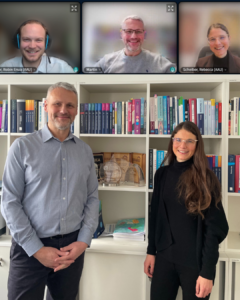
Rebecca Scheiber: Thank you very much, for taking the time and to talk to us and, for joining this interview today. And first of all, we would really like to congratulate you to your great achievement and for receiving the Flemming Hansen Award. Congratulations! We’ve seen that you’ve won like also a lot of best paper awards from the Journal of Advertising multiple times. And now you’ve received the Flemming Hansen Award. And this represents a crowning achievement also in your career. We would like to ask you, how does it feel to receive such an award and such a prestigious recognition?
Martin Eisend: Thank you so much for the congratulations. I feel honored and also very happy about the award. You know, it’s a lifetime achievement award, so it’s really an outstanding award, amongst other awards. In addition it is the most prestigious award given by the European Advertising Academy, an organization that’s very dear to me.
Rebecca Scheiber: Great. What achievements in your career give you the most personal satisfaction, beyond awards?
Martin Eisend: It’s a good question. Honestly, I feel actually pretty grateful that I have a job that is fulfilling and satisfying. What you consider as the most satisfying achievements changes over the years. But nowadays, I would say that anything you achieve in a team is always most rewarding. You just feel it’s very special if it’s a team effort. And beyond that, what really satisfied me personally is not necessarily always what happens in my professional life.
Rebecca Scheiber: Oh, I see, great. I think this leads to our next question. Robin and me, we were very much impressed by our high publication output. You have an exceptionally high publication output as well. So, can you tell us how do you manage to maintain such a productivity and what is your drive?
Martin Eisend: I guess you always get the same answers. It has to do with some passion for what you’re doing. You need to have interest in research in general and also the topics you’re investigating. But I think nowadays I would say most important is with whom you’re working, with motivated people, good people. And I have been really blessed to have wonderful colleagues, wonderful researchers I have been working with over the years. I think that’s one of the main drivers.
Robin Hauser: Thank you. We would like to know a little bit about your methodological expertise. Given that you’re an expert in conducting meta-analysis, we wanted to know where does your passion for this method come from?
Martin Eisend: You know, I was running a meta-analysis during my PhD thesis. I didn’t know anything about meta-analysis. I had to do a literature review and my supervisor came and he said, do you want to do a literature review or a meta-analysis? And I thought like, oh, what’s that? Let’s look that up. And somehow I just got stuck with the method. I think if you develop a certain expertise, it always comes with some kind of passion. That’s maybe one of the reasons. And then I think also it’s a very dynamic method. And looking at how it is being used nowadays compared to the time I did a PhD, it’s a pretty successful method. It’s kind of easy to be fascinated by it.
Robin Hauser: Great answer. So, it was a modest start for you with the meta-analysis, so to speak. The next question is, AI is increasingly capable of automating parts of research. What risks do you see? If AI were to, let’s say, take over certain or most parts of the meta-analysis process – how can we safeguard scientific quality in this area?
Martin Eisend: That’s a very, very up to date and very interesting question. This takeover is already happening. AI is always increasing efficiency, especially of many very cumbersome tasks no one wants to do, like, literature search, coding for meta-analysis. This is going to be taken over by AI. And as you said, it currently comes at the cost of, quality loss. We have a dramatic increase in efficiency. But at a cost of slightly decreasing quality, which is acceptable for other areas like businesses but not in research. We cannot accept any quality loss. I believe that this is going to change in the very near future. First of all, because the AI tools are getting better, they are learning, they are improving. And second, we as researchers, we will also develop some skills and methods to maintain the highest scientific standards. So it’s going to be a cooperation between humans and machines. The bottom line is that AI is certainly changing the way we do research, including meta-analysis. And it will also change the roles that we as researchers have in research projects in the future.
Robin Hauser: Okay. Thank you so much. The final methodological question is: what do you see as the central methodological challenges in meta-analysis, especially for young researchers or researchers that do not have much experience with the method yet. And how could they best be addressed?
Martin Eisend: I wouldn’t say this is something specific to meta-analysis, but when it comes to methods, the general advice is you have to stay on top of the methodological developments. So you should know where the journey is heading. What’s actually state of the art of a method? What are you going to do? I see papers often getting rejected, not necessarily only because of the method, but one of the reasons is often that people don’t provide state of the art methodology. So that’s what you need to do as a researcher. I don’t think you need to know all the details. You keep an overview of the methodological developments and for very detailed questions, you can always work together with other people who know the details. Maybe one thing I noticed in recent years, when it comes to meta-analysis, is that we are moving away from single method papers to multi-method papers. So the meta-analysis is the core study accompanied by a survey or an experiment. I think this is going to be the future. I’m not saying that’s good or bad. It’s just where the journey is heading.
Robin Hauser: Wow. Great. Thank you. That’s super helpful.
Rebecca Scheiber: Thank you very much for your insights on the methodological side. So, we’re moving again to questions relating to your personal motivation and aspiration. So, who or what has been the biggest influence on your career in especially advertising research?
Martin Eisend: I think professionally, that was certainly my PhD supervisor. He was the one who was pushing me not just towards using a certain methodology. He was the one who gave me the confidence in pursuing an academic career. I didn’t dare to do that, but he gave me the confidence. I would say that’s the biggest influence for a career if you have people who really believe in you.
Rebecca Scheiber: I totally agree. What fascinates you most about advertising research and what keeps you engaged in this field, like, after so many years? I think you mentioned passion. think that is one thing, but is there something to add?
Martin Eisend: That’s also a question I sometimes ask myself. I think advertising is interesting because it’s kind of a micro cosmos of what’s going on in the world. We deal with a lot of topics that are also important in the world in general. We’re dealing with environmental issues, with health issues, with diversity, even with politics. It’s all somehow reflected in advertising. And that makes it very interesting for many different people and from many different points of view. What I also like, it’s a topic that’s a bit about dreams and wants. So, what people want, what they could achieve. And this gives it a positive notion and I like to have an optimistic view on the world. The world is not always a good place, but I think it’s important to keep an optimistic view. And another thing is, and I mentioned that already, the advertising research community is a very nice community with very nice people. I do like to work with them. If that wouldn’t be the case, if it would be a community where everyone hates each other, I think I probably wouldn’t be there.
Rebecca Scheiber: Thank you so much for your insights here. That’s really nice. Ok, I think the next question is a very interesting question. As a child, what profession did you ever dream of pursuing? And did you ever imagine yourself as a researcher in advertising?
Martin Eisend: No, I didn’t imagine becoming an advertising researcher. Actually, I have been raised up in a very Catholic environment and my first wish for very long time was becoming a priest. Obviously, it didn’t work out.
Rebecca Scheiber: That’s interesting. Thanks for sharing your childhood dream. Thank you so much.
Robin Hauser: We have two more personal questions and then we would like to wrap it up with a quick word rap. But first, we would still like to know if you could give your younger self one piece of career advice. Like if you imagine yourself as a child or a young teenager or something like that, what would you like to tell them in terms of their future career?
Martin Eisend: You know, if you would have asked me that ten years ago, I could have given you several answers. But now I’m somehow at an age where I stop regretting life choices and just accept to live with them. So it’s a bit difficult to say what I would have done differently. I think in general it’s important that you try to be a good person. That’s an important thing. And if you work on that, a lot of good things will come along the way. Being a good person, trying to contribute somehow that the world is a better place. I think that’s always good advice. Very general, though. I’m sorry. So, nothing very specific.
Robin Hauser: That’s perfect. Thank you so much. And, maybe a quick follow up question. Is there any advice, any general advice as well, that you could give for young researchers, aspiring researchers, maybe in the advertising industry?
Martin Eisend: Yeah, I think in advertising research, I would say try to develop a competitive advantage. So, either be an expert in a method or be an expert for a certain topic. That always gives you an advantage in your career. I would also say develop some passion for it. Passion is a big word. Try to like what you do. If you’re not interested in it, you will never succeed. And work with people, listen to people, take their advice seriously and pick good people you like to work with. And I can tell you the advertising research community offers a lot of them. So that was actually not just one piece of advice. I’m sorry.
Rebecca Scheiber: That’s great.
Robin Hauser: Great. Thank you so much. Okay. This concludes the main questions of the interview. And if you’re up for it, we would like to sum the interview up with a quick word rap. And this works as follows. We are going to provide you with two options and from the top of your head, you can decide which one you prefer. It’s about your personal opinion so that people get to know you a little from reading the interview. I’ll start with the first one:
Robin Hauser: Advertising campaigns: bold and risky are safe and proven?
Martin Eisend: Bold and risky.
Robin Hauser: Working routine: structured planner or spontaneous thinker?
Martin Eisend: More structured planner.
Robin Hauser: Office or home?
Martin Eisend: Office, definitely.
Robin Hauser: Early bird or night owl?
Martin Eisend: (Laughs) Early bird but not because I like it.
Robin Hauser: Coffee or tea?
Martin Eisend: Definitely coffee
Robin Hauser: Risotto or Wiener Schnitzel?
Martin Eisend: Wiener Schnitzel. No question.
Robin Hauser: And final question. Short trip to the sea or adventurous hike in the mountains?
Martin Eisend: Trip to the sea. I prefer to be lazy.
Robin Hauser: Okay, thank you so much for taking the time to answer our questions!